Seeing yourself in comics

Updated: Aug 8, 2025
Traditionally, comics—and graphic novels—have focused on telling the story of a character. The exploits of colorful heroes and their adventures beyond everyday life make the format exciting and immersive, offering readers narratives far removed from their own experiences.
A key part of the comic reading experience has always been self-identification: the ability for readers to empathise with characters and imagine themselves in their place. As comics have evolved over the past few decades, driven by technological advances, shifting audience expectations, and their popularisation through television and cinema, the "standard" of comic art has changed significantly. In this evolution, something arguably has been lost.
Scott McCloud, in his influential work Understanding Comics: The Invisible Art, emphasises the importance of simplified character design in comics. When characters are drawn simply and abstractly, it becomes easier for readers to project themselves into the story. Rather than observing from the outside, they inhabit the characters, imagining that the characters' choices are their own.

In the early days of comics, limited budgets and crude production technologies naturally led to simplified imagery. Character faces were often mask-like—minimalist and symbolic—making it easier for readers to step into their shoes.

Over time, the simplicity often became a choice. Budget could be a determining factor in the decision-making, however, the crudity of many productions aimed at children relied on the audience to fill in the gaps and make the story work (Stankovic, 2024).
This technique can be seen clearly in works like Tintin, where characters, especially Tintin himself, are drawn with striking simplicity. His round face, dot eyes, line mouth, and basic nose are more akin to emojis than realistic portraits. While the characters remain simple, the detailed and realistic environments ground the narrative, creating a balance between imagination and immersion.

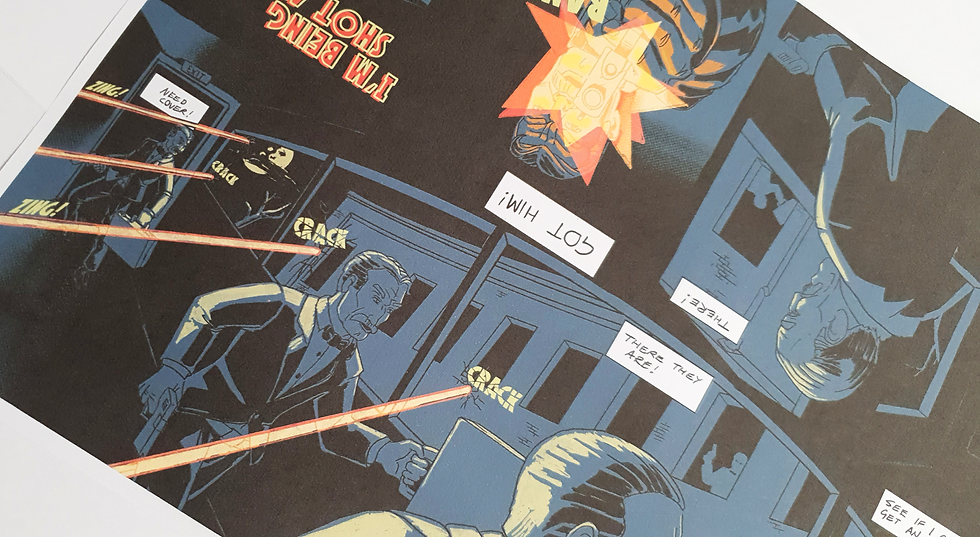
In contrast, many contemporary comics opt for a more intricate, “realistic” art style. While this enhances the cinematic quality of action and adventure, it may reduce the space for reader identification and imagination. The more specific and detailed the character, the harder it may become for the reader to see themselves in their place. Has something essential been lost in this shift toward realism? Were older comics more powerful because of their simplicity, or is that just nostalgia?
This leads me to my question; how simple, reduced or abstract does the visual storytelling of a comic need to be to allow the level of connection that has been lost? And how can this be tested?
Something I need to work on.
Works Cited:
McCloud, S. (1994). Understanding Comics: The Invisible Art. HarperPerennial.
Stankovic, S. (2024, August 2). Protagonist as a Blank Slate. Medium. https://stanislav- stankovic.medium.com/protagonist-as-a-blank-slate-64ed8c59e543


Comments