Thinking in Circles
- Duncan Maclean
- Dec 2, 2025
- 4 min read

Updated: Aug 13
The concept of repetition has always intrigued me—not just in behaviour or visual motifs, though those are fascinating too—but specifically in plot, narrative, and theme. Circular narratives, in particular, are a popular device across storytelling mediums. The form of the medium doesn’t matter: written works, video games, television, cinema, or streaming content all employ circular narratives effectively. What truly matters is how the story begins and ends.
Before delving further, it’s important to clarify some terminology. In everyday conversation, the terms plot, story, and narrative are often used interchangeably, but they serve different functions. For the sake of precision, I will define and use these terms carefully.
In this context, narrative refers to the overarching theme, message, philosophy, or moral conveyed through the story and its events. Plot consists of the specific events, actions, or decisions made by—or experienced by—the characters that move them through the settings and circumstances of the story (Savage Books Literary Editing, 2022). Story is a broader term that encompasses both narrative and plot elements.
A circular narrative is one where the beginning and ending of a story are the same or strikingly similar. Typically, this involves a character situated in a familiar context. This context is comfortable and known until an event prompts the character to leave and embark on a journey. Eventually, the character returns to their original context, which remains largely unchanged; however, their perspective and understanding have transformed (Hellerman, 2022). It is this contrast between the story’s beginning and end that fuels the emotional resonance of a circular narrative (Reichenbach, 2025).
The scope of a circular narrative can vary significantly. Many comics, television series, and sitcoms rely on circularity from episode to episode. Most episodes end with characters and relationships restored to their initial state, facilitating easy entry into the next episode. Gradual character development is often subtle but cumulative within this episodic circular structure (Industrial Scripts, 2022). In contrast, a film series like The Lord of the Rings employs circular narrative on a grander scale, with Frodo returning to the starting point of The Fellowship of the Ring after nearly nine hours of epic adventure and conflict.
It’s important not to conflate a circular narrative with a circular plot. The latter often involves clever time-travel mechanisms to explain plot points. For example, The Terminator utilises a circular plot structure: while the narrative itself is not circular, the ending’s implication that the antagonist’s remains lead to its own creation hints at a circular loop. Similarly, Tenet explores high-concept sci-fi time travel, and even family-friendly fare like Disney’s Your Friendly Neighbourhood Spider-Man uses time-travel elements, where Peter Parker’s own actions become the catalyst for his becoming Spider-Man.
I aspired, somewhat ambitiously, to integrate both circular narrative and circular plot elements into this project.
But how might this work in comics? Well, traditionally, Western comics are read left to right, top to bottom, starting on page one and ending somewhere down the line, often in ongoing series. How does one tell a circular narrative in this space? The answer, I realised, had been before me all along. The mini-comic format I have been using is essentially circular. All eight pages exist on a single sheet, which, when cut and folded, forms a loop of paper that can be read in any direction, as many times as desired. This led me to realise that a title page—though useful—is simply a convention. A story that is circular in both nature and form has no start or end; it simply chases itself round and round.
The next step was to devise a premise that could loop back on itself within just eight panels, which was challenging. The opening premise must be clear and quickly understood to establish context for the reader (Reichenbach, 2025). Therefore, I relied heavily on archetypes familiar to a Western audience. The comic centres on a spy burdened with a briefcase—a common and enduring MacGuffin in storytelling. The spy, besuited and moustachioed, nods to the retro gentleman spy archetype.
The plot needed to be straightforward. Our hero possesses the MacGuffin and must protect it from a shadowy figure intent on stealing it. I wanted the scenario to be immediately apparent, with simple, comprehensible decisions driving the action. Movement—or its comic equivalent—would propel the plot. I aimed for a Jason Bourne-style tension, not a suave James Bond. The spy’s journey through the space would guide the reader through the panels.
Returning to circularity, our hero is, in fact, defending the case from himself. The “first” page depicts him being shot at, while the last reveals he fired those shots.
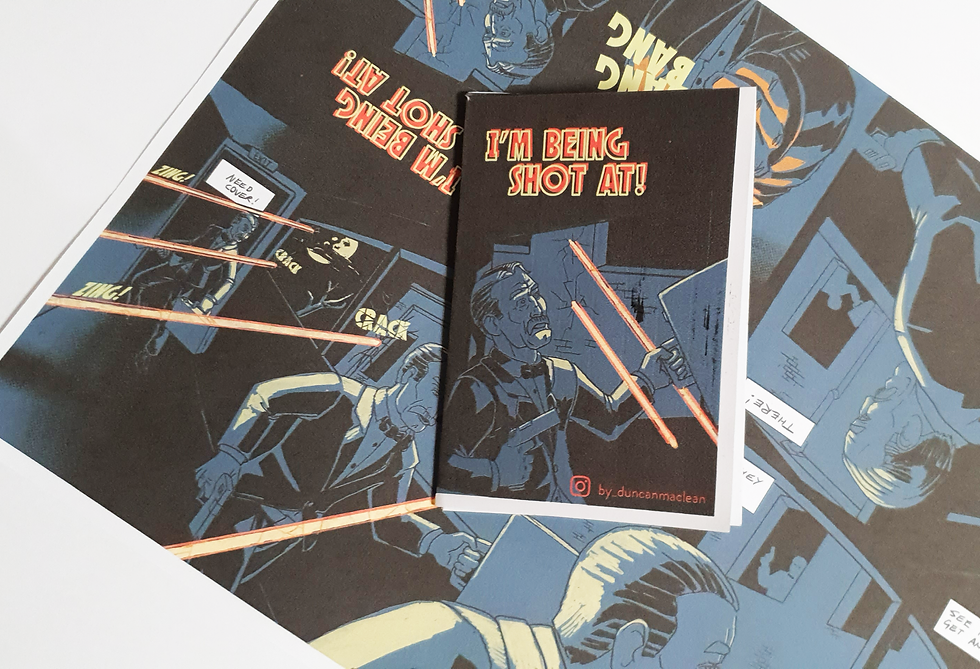
Thus, the plot never truly ends. Within this brevity, the broader message or philosophy typically carried by the narrative is somewhat diminished (Savage Books Literary Editing, 2022). Instead, the reader is invited to interpret and assign their own meaning and value.
Though there is an established entry point, the story smoothly folds back onto itself. Our spy is endlessly running from—and pursuing—himself, oblivious to the loop trapping him.

Visually, this format offered an opportunity to experiment with longer, continuous images. The traditional comic gutter—used to separate panels—is significant, but not indispensable, for guiding reader comprehension. Given space constraints, I chose to forgo panels, letting each page break delineate action instead. Some images spanned several pages, with folds enabling sequencing. This appealed to me, as it created a more seamless flow that echoed the circular motion I wanted to evoke.

Ultimately, this small experiment deepened my understanding of circularity—not just as a narrative device but as a structural and visual concept. The mini-comic format reinforced that beginnings and endings are often matters of perspective, and that a story can continue looping long after the reader has looked away. I’m Being Shot At! became less about creating a clever twist and more about embracing a form that folds back on itself, inviting rereading, reinterpretation, and a sense that the chase never truly resolves. If nothing else, it demonstrates that even in a medium built on sequence, a story doesn’t always need a straight line—it can run laps instead.
Works Cited:
Hellerman, J. (2024, May 24). Are You Using Circular Storytelling? The Pros and Cons of This Tactic. No Film School. https://nofilmschool.com/circular-storytelling-pros-cons
Industrial Scripts (2022, August 18). What is Circular Storytelling? The KEY Lessons For Story Structure. https://industrialscripts.com/circular-storytelling/
Reichenbach, B. (2025, September 14). Circular and Episodic Narratives: Breaking Linear Expectations. Deep Lore. https://www.deeplore.show/circular-episodic-structures/
Savage Books Literary Editing. (2022, April 20). Eren Yeager and the Insanity of Circular Storytelling [Video discussion on circular narratives]. Youtube. https://www.youtube.com/watch?v=PQ7fS4uHznU&t=199s


Comments